

Siglent SNA6000-VMM vector mixer measurement option (software)
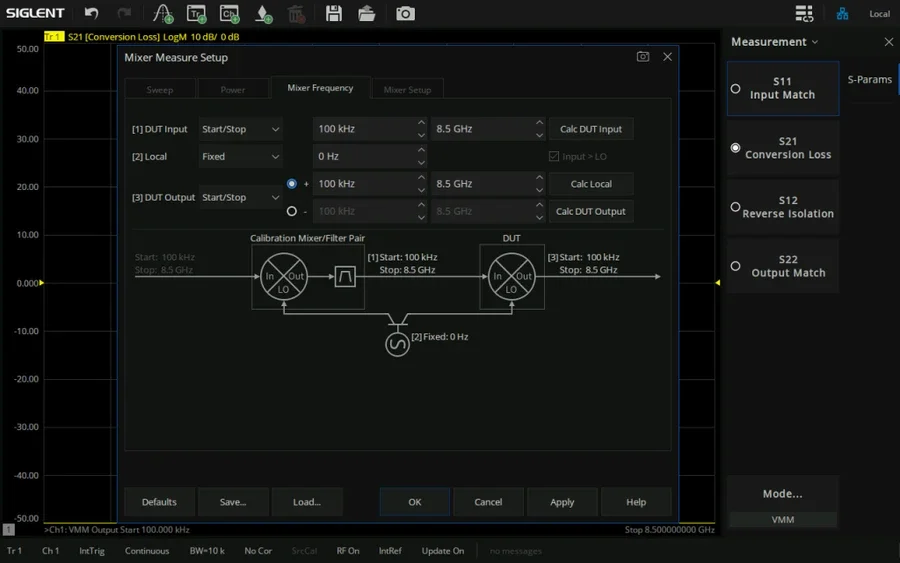
Vector mixer measurement for the SNA6000A VNA: conversion loss with phase and group delay using a calibration mixer, LO from port 3/4 or external.
SNA6000-VMM — vector mixer measurement
Vector S-parameters of mixers and frequency converters: conversion loss with phase and group delay, measured with the alternating-frequency-conversion method and a calibration mixer/filter pair.
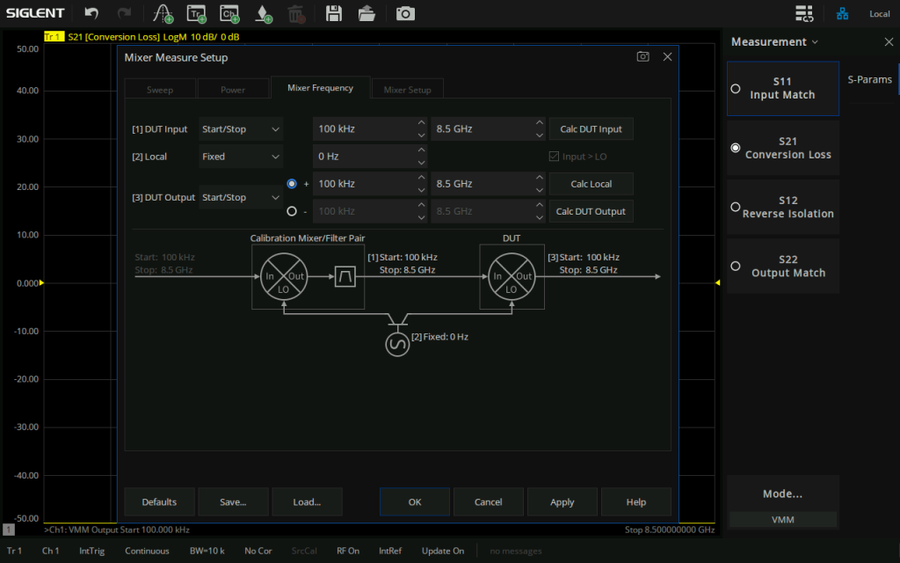
A scalar mixer measurement gives conversion loss as a magnitude; the phase is invalid because the transmission tracking term is a scalar. VMM restores the vector: the analyser measures the device under test together with a calibration mixer/filter combination that converts in the opposite direction, so the pair behaves like a through and the phase of the conversion — and from it the group delay — becomes measurable. Input, LO and output ranges are set in one dialog; the LO can come from an external generator or, on the 4-port models, from one of the analyser’s own ports.
What this option does
What it does
Adds the VMM measurement mode: vector S21 conversion loss with phase and group delay, S11 at the input frequency, S22 at the output frequency and S12 reverse isolation, with a vector mixer calibration wizard and optional source-power calibration.
What you use it for
Up- and down-converters whose phase linearity or group delay matters: satellite and radar front ends, IF chains, and any converter that sits inside a phase-sensitive or wideband modulated signal path.
In practice
A Ku-band down-converter must keep group-delay ripple under 2 ns across a 500 MHz channel. VMM with a calibration mixer in the up-conversion direction shows the ripple directly in nanoseconds, where SMM could only have shown the conversion-loss magnitude.
VMM needs a calibration mixer/filter combination that works in the opposite direction to the device (device down-converts: calibration mixer up-converts, and vice versa), a power divider and an LO: on the 4-port models the internal source on port 3 or 4 can supply it; the 2-port models need an external signal generator, which the analyser can also control. SMM and VMM are separate licences; the vector mode does not require the scalar one. Warm the set-up up and keep the noise-suppression setting the same for calibration and measurement.
What is in the vector mixer application
Conversion loss with phase
S21 as a vector, not just a magnitude, after vector mixer calibration.
Group delay
Derived from the conversion phase — the figure SMM cannot give.
Match at both frequencies
S11 at the input frequency, S22 at the output frequency, S12 reverse isolation.
Alternating frequency conversion
The device and the calibration mixer form a through, so the phase reference survives the frequency translation.
LO control
Fixed external LO, a variable LO from port 3/4 (4-port models), or an external generator controlled by the analyser.
Sweep types
Frequency sweep, power sweep of input or LO, CW time, segment sweep.
Calibration wizard
Vector mixer calibration with a calibration kit or ECal; source-power calibration with a power meter optional.
One setup dialog
Input, LO and output ranges, up or down conversion, image selection and sweep in the Mixer Measure Setup.
Specification
From the SNA6000A data sheet and user manual.
| Measurement mode | Meas → S-Params → Mode → VMM, in the active or a new channel |
| Parameters | S21 conversion loss (vector) · group delay · S11 input match · S22 output match · S12 reverse isolation |
| Method | Alternating frequency conversion with a calibration mixer/filter pair in the opposite conversion direction |
| Needs | Calibration mixer/filter combination · power divider · LO source (port 3/4 on 4-port models, or external generator) |
| Calibration | Vector mixer calibration wizard; optional source-power calibration with a power meter |
| Sweep types | Frequency · power (input or LO) · CW time · segment |
| Related licence | SNA6000-SMM for scalar mixer measurement (separate option, not required) |
| Models | All eight SNA6000A models |
Compatibility and activation
Works on all eight models. The 4-port analysers can supply the LO from port 3 or 4; the 2-port analysers need an external LO generator.
Supplied as a licence key issued against the analyser’s serial number — nothing to fit and nothing to return. Enter it under System → Options → License…, or load the .lic file from a USB stick. Ordered together with a new SNA6000A, Siglent activates it at the factory.
Questions about SNA6000-VMM
What is the difference between SMM and VMM?
SNA6000-SMM measures conversion loss as a magnitude, plus reflection and power; its phase is not valid. VMM adds the vector: phase of the conversion and group delay, using a calibration mixer.
What is a calibration mixer?
A mixer and filter you provide, converting in the opposite direction to the device, so that device plus calibration mixer act as a through at the analyser’s frequency. Its characteristics are removed by the vector mixer calibration.
Where does the LO come from?
On the 4-port SNA6024A, SNA6124A, SNA6034A and SNA6134A from port 3 or 4. On the 2-port models from an external generator, fixed or controlled by the analyser.
Do I need SMM as well?
No. The two are independent licences; Siglent lists them separately in the data sheet.
Is a power meter required?
Only for the optional source-power calibration, which improves absolute power readings.
How is the licence delivered?
Supplied as a licence key issued against the analyser’s serial number — nothing to fit and nothing to return. Enter it under System → Options → License…, or load the .lic file from a USB stick. Ordered together with a new SNA6000A, Siglent activates it at the factory. Add the analyser’s serial number to your order, or send it to us afterwards.
Can I return a licence?
Software licences and activation keys are delivered electronically and are excluded from the 14-day EU return right once the key has been issued. If you are unsure, ask us first.
Planning an SNA6000A measurement?
Tell us the device, the frequency range and what you need to measure. We will confirm the model, the options and the calibration you need before you order.