

Siglent SDS7000A-CT-DDR DDR compliance test (software)
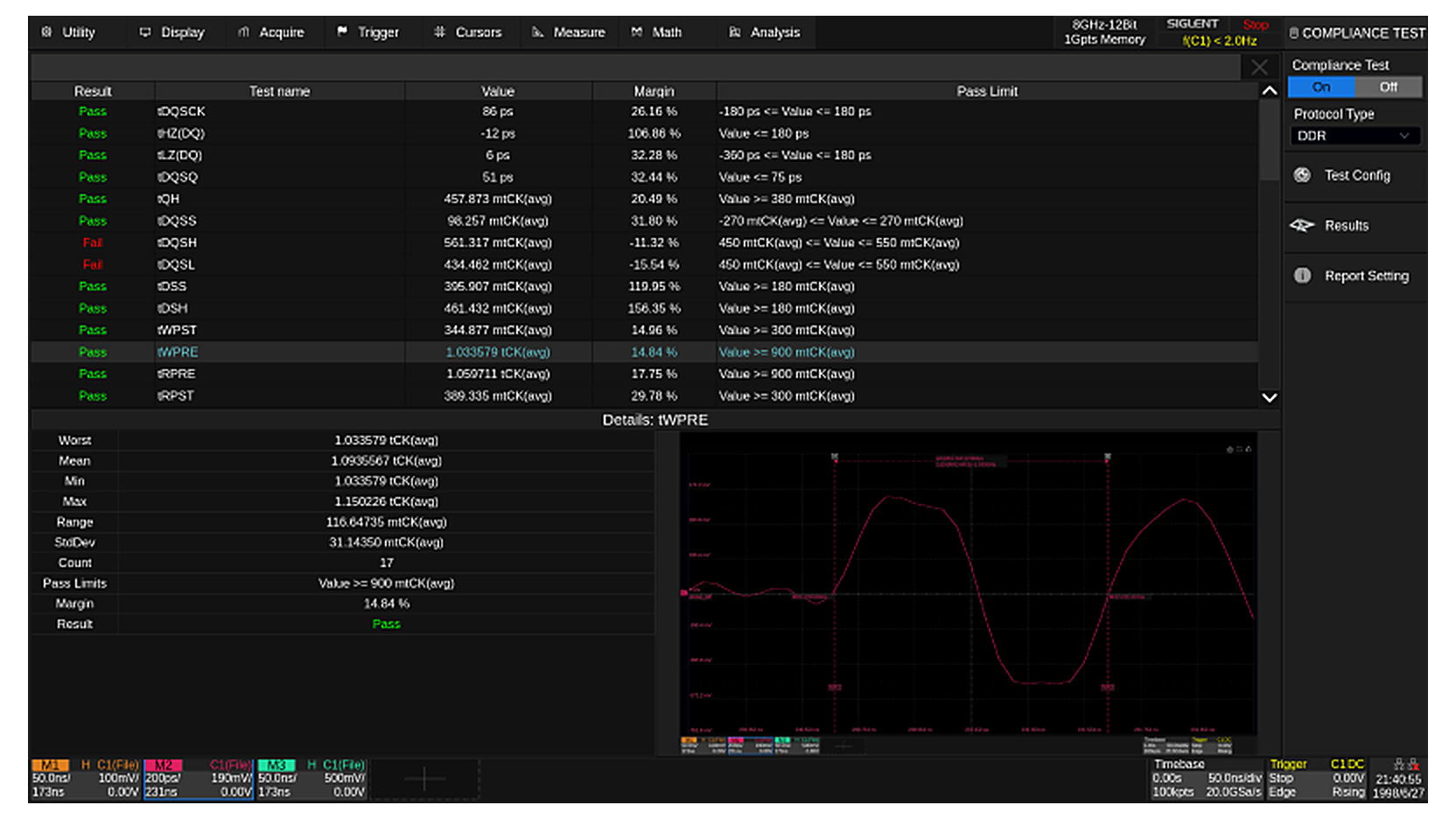
Siglent SDS7000A-CT-DDR is DDR memory compliance test to the JEDEC specifications — clock, timing, electrical and eye-diagram tests, automated. For the SDS7000A. ( license option )
SDS7000A-CT-DDR — DDR compliance test (software)
DDR memory compliance test to the JEDEC specifications — clock, timing, electrical and eye-diagram tests, automated.
Supplied as a licence key issued against the instrument's serial number. There is no hardware to fit and nothing to return: the code is entered in the instrument's own menu and the function is available immediately, on the instrument you already own.
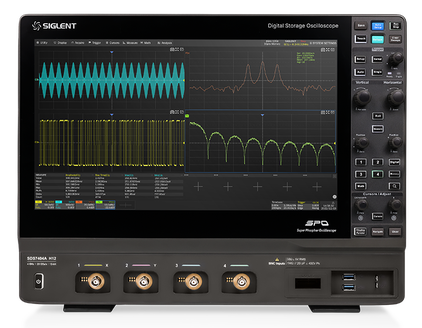
What this option does
What it does
Runs the JEDEC DDR compliance suite on the oscilloscope. The price list names DDR2 and DDR3; the current data sheet (EN04A) lists DDR2 (JESD79-2F, JESD208), DDR3 (JESD79-3F), DDR3L (JESD79-3-1A.01) and DDR4 (JESD79-4D). It covers the clock tests (tCK, tCH, tCL, period, cycle-to-cycle and duty-cycle jitter, tERR), the read and write timing tests (tAC, tDQSCK, tDQSQ, tQH, tDQSS, setup and hold, preambles and postambles, data valid window), the electrical tests (input and output levels, crosspoints, slew rates, overshoot and undershoot) and the DQ eye-diagram tests.
What you use it for
Memory-interface signal integrity decides whether a board boots at all, and the JEDEC limits are dozens of measurements with their own reference levels. Run by the instrument they take minutes and produce a report; run by hand they take a day and the mistakes are silent.
In practice
A new board boots at room temperature and fails warm. The suite shows tDQSQ skew on two byte lanes at the limit; a layout change on those lanes fixes it before the first production run.
Probing DDR needs high-bandwidth differential or solder-in probes on the DQ, DQS and clock nets (SAP5000D or SAP8000D with solder-in heads). The key is issued against the oscilloscope’s serial number.
What the suite tests
From the SDS7000A data sheet EN04A.
| Standards | DDR2 (JESD79-2F, JESD208), DDR3 (JESD79-3F), DDR3L (JESD79-3-1A.01), DDR4 (JESD79-4D) — data sheet EN04A; the price list names DDR2/DDR3 |
| Clock tests | tCK(abs), tCK(avg), tCH(avg), tCL(avg), tCH(abs), tCL(abs), tJIT(per), tJIT(cc), tJIT(duty), tERR(nper) |
| Timing tests | tAC, tDQSCK, tLZ/tHZ (DQS, DQ), tDQSQ, tQH, tDQSS, tDSS, tDSH, DQS pulse widths, write and read preambles and postambles, tDS/tDH, tIS/tIH, tIPW, tDIPW, tVAC, tQSH/tQSL, tDVWp |
| Electrical tests | Input and output voltages, VIHL_AC, VID, VIX/VOX, VIX.Ratio(DQS), single-ended and differential slew rates, overshoot and undershoot amplitude and area, VREFCA |
| Eye-diagram tests | DQ eye for write or read bursts, Rx mask DQS-to-DQ offset (tDQS2DQ) |
| Probing | Differential or solder-in probes on DQ, DQS and clock (SAP5000D, SAP8000D with solder-in heads) |
Compatibility
The option runs on every SDS7000A model. Fixtures and compliance applications are the same on the A and AP models.
| Model | Bandwidth / channels | SDS7000A-CT-DDR |
|---|---|---|
| SDS7304A H12 | 3 GHz · 4 ch · A model (H12) | Compatible |
| SDS7404A H12 | 4 GHz · 4 ch · A model (H12) | Compatible |
| SDS7604A H12 | 6 GHz · 4 ch · A model (H12) | Compatible |
| SDS7604AP | 6 GHz · 4 ch · AP: 20 GSa/s on all channels | Compatible |
| SDS7804A H12 | 8 GHz · 4 ch · A model (H12) | Compatible |
| SDS7804AP (on request) | 8 GHz · 4 ch · AP: 20 GSa/s on all channels | Compatible |
The SDS7804AP is listed in Siglent’s price list and data sheet; ask us for price and availability.
Related options and accessories
Questions about SDS7000A-CT-DDR
Do I need a fixture?
There is no Siglent DDR fixture; DDR is probed on the board. Use high-bandwidth differential or solder-in probes (SAP5000D, SAP8000D with solder-in heads) on DQ, DQS and clock.
Which SDS7000A models run it?
All of them — the A models and the AP models. For the fastest interfaces the higher-bandwidth models leave more margin in the measurement, but the application itself is the same key on every model.
Is the report a certificate?
It is pre-compliance evidence: the standard’s own test items with pass/fail against the limits and the captured waveforms. It tells you what a test house will find before you book one; it does not replace the test house where formal certification is required.
How is the licence delivered?
Supplied as a licence key issued against the instrument's serial number. There is no hardware to fit and nothing to return: the code is entered in the instrument's own menu and the function is available immediately, on the instrument you already own. Add the instrument’s serial number to your order, or send it to us afterwards — the key is issued against it.
Can I return a licence?
Software licences and activation keys are delivered electronically and are excluded from the 14-day EU return right once the key has been issued. If you are unsure which key you need, ask us first — with your serial number we can confirm it.
Not sure this is the right key?
Send us your serial number and what you want to measure. We will confirm the exact option before you order.