

Siglent SSA3000XR-RT40 40 MHz real-time bandwidth option (software)

Siglent SSA3000XR-RT40 Measurement license optionto widen the SSA3000X-R real-time span from 25 to 40 MHz: gap-free density, spectrogram and PvT, 7.20 µs POI and 40 MHz digital modulation analysis.
SSA3000XR-RT40 — 40 MHz real-time bandwidth
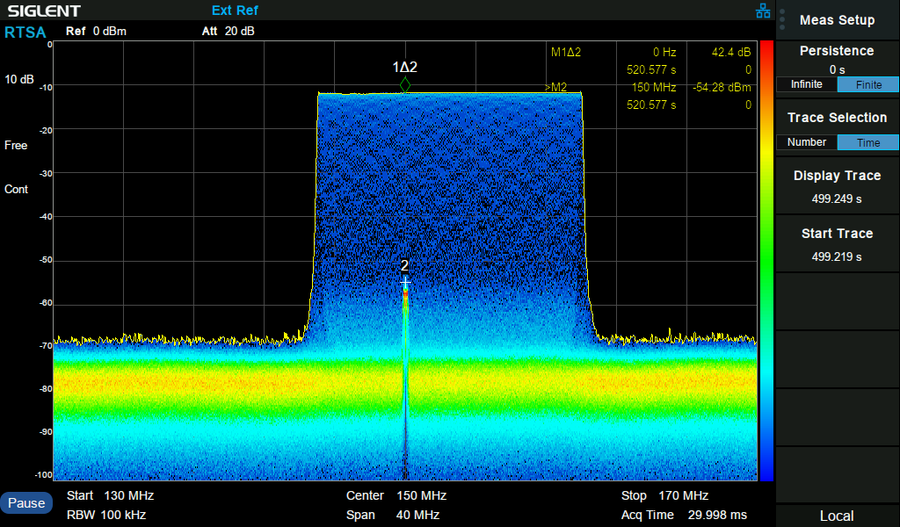
Widens the real-time bandwidth of the SSA3000X-R from 25 MHz to 40 MHz: a 40 MHz wide, gap-free view in density, spectrogram, 3D and power-versus-time.
In real-time mode the SSA3000X-R does not sweep. It digitises a whole slice of spectrum at once and processes every sample, so a burst, a hop or a collision inside that slice cannot fall between two sweeps. That slice is 25 MHz wide as standard. This key makes it 40 MHz — room for a 40 MHz Wi-Fi channel, or several narrow channels and the interferer between them, in one capture. Digital modulation analysis uses the same bandwidth, so it widens that to 40 MHz as well.
What this option does
What it does
Raises the maximum real-time span from 25 MHz to 40 MHz. Across that span the analyser keeps a 100 % probability of intercept down to 7.20 µs, with RBWs from 100 kHz to 3.3 MHz, a frequency-mask trigger and up to 50 000 stored spectrogram and PvT frames.
What you use it for
Watching signals that are wider than 25 MHz, or that move around inside a wider band: frequency hoppers, 40 MHz Wi-Fi channels, radar and pulsed links, and intermittent interference whose frequency you do not know in advance.
In practice
A 2.4 GHz product drops packets only when a neighbouring device is active. Centred between the two, the 40 MHz density view shows both signals together, and the spectrogram shows the moment they overlap. A frequency-mask trigger stops the capture on the first collision, so you can step back through the history and see what led up to it.
The real-time span is how much spectrum is captured at once, not the frequency range. You can centre the 40 MHz window anywhere in the instrument’s range. A band wider than 40 MHz — the whole 83.5 MHz of the 2.4 GHz ISM band, for instance — still needs the swept spectrum analyser view or more than one real-time capture.
25 MHz or 40 MHz?
What fits in one real-time capture, with and without the key.
| Standard | With RT40 | |
|---|---|---|
| Widest real-time span | 25 MHz | 40 MHz |
| Analysis bandwidth of digital modulation analysis (SSA3000XR-WDMA) | 25 MHz | 40 MHz |
| A 20 MHz Wi-Fi or LTE channel in one capture | Yes | Yes |
| A 40 MHz Wi-Fi channel in one capture | No | Yes |
| The whole 2.4 GHz ISM band (83.5 MHz) in one capture | No | No — use swept mode |
Real-time mode with 40 MHz
From the SSA3000X-R data sheet and user manual.
| Real-time bandwidth | 25 MHz standard · 40 MHz with SSA3000XR-RT40 |
| 100 % POI at 40 MHz span | 7.20 µs minimum signal duration (widest RBW, Kaiser window, full amplitude accuracy) |
| RBW at 40 MHz span | 100.43 kHz to 3.3142 MHz (Kaiser) · six RBW settings per window |
| Maximum sample rate | 51.2 MHz |
| Minimum span | 5 kHz |
| Views | Density, spectrum + spectrogram, spectrogram, PvT + spectrum, 3D + spectrogram |
| Acquisition time per view | Density and 3D + spectrogram: 30 ms to 50 s · spectrogram and PvT + spectrum: 100 µs to 50 s |
| History | Up to 50 000 spectrogram / PvT frames, stored in a loop |
| Windows | Kaiser (default), Hanning, Flattop, Gaussian, Blackman-Harris, Rectangular |
| Detectors and traces | +Peak, −Peak, Sample, Average · 3 traces · 8 markers |
| Trigger | Free run, PvT, external, and frequency-mask trigger (greater than, less than, inside or outside the mask; stop or beep) |
| Density display | 0 to 100 %, 0.1 % resolution · persistence finite or infinite |
| Spectrogram dynamic range | 200 dB |
| Amplitude flatness | < 0.4 dB |
Compatibility and activation
Supplied as a licence key issued against the instrument’s serial number. There is no hardware to fit and nothing to return: the key is entered under System → System Info → Load Option.
Real-time analysis is specific to the SSA3000X-R. The SSA3000X and SSA3000X Plus are swept analysers and cannot use this key.
Goes with
Questions about SSA3000XR-RT40
Does this change the frequency range of my analyser?
No. The SSA3032X-R, SSA3050X-R and SSA3075X-R keep their 3.2, 5.0 and 7.5 GHz range. The key changes how wide a slice of that range the real-time mode captures in one go: 40 MHz instead of 25 MHz.
Do I need it?
Only if what you look at is wider than 25 MHz, or moves around inside a band wider than that. Narrow signals — a 20 MHz channel, a Bluetooth or LoRa link, a clock harmonic — fit in the standard 25 MHz. If in doubt, tell us the signal and we will say whether it fits.
Does it make the probability of intercept better?
Siglent states a 7.20 µs minimum signal duration for 100 % POI at 40 MHz span with the widest RBW. Narrower RBWs need longer events; the data sheet lists the figures per span and RBW. The key’s purpose is the wider span, not a shorter POI.
Does it help digital modulation analysis?
Yes. SSA3000XR-WDMA uses the real-time bandwidth as its analysis bandwidth, so with this key it can demodulate signals up to 40 MHz wide instead of 25 MHz. The WDMA licence is sold separately.
Does the swept spectrum analyser mode change?
No. Swept mode already covers the instrument’s full frequency range; this key widens what real-time mode and modulation analysis capture at once.
Does it work on every SSA3000X-R?
Yes — the SSA3032X-R, SSA3050X-R and SSA3075X-R. The key is tied to one instrument’s serial number.
I have an SSA3000X or SSA3000X Plus.
This key is for the SSA3000X-R only. Real-time spectrum analysis is a feature of the -R series; the SSA3000X and SSA3000X Plus are swept analysers.
How is the licence delivered?
Supplied as a licence key issued against the instrument’s serial number. There is no hardware to fit and nothing to return: the key is entered under System → System Info → Load Option. Add the instrument’s serial number to your order, or send it to us afterwards — the key is issued against it.
Can I return a licence?
Software licences and activation keys are delivered electronically and are excluded from the 14-day EU return right once the key has been issued. If you are unsure, ask us first.
Not sure 25 MHz is too narrow?
Tell us the signal you need to capture — its bandwidth, how it moves, what interferes with it. We will tell you whether the standard real-time bandwidth already covers it.