

Siglent SP3050A 500MHz Oscilloscope Probe

Siglent SP3050A 10X attenuation,11 pf,10 Mohm,
500 MHz,CAT Ⅱ 400 Vrms,operating temperature 0 to 50 degrees
500 MHz passive probe, 10X, 11 pF
The SP3050A is a fixed 10X passive probe reaching 500 MHz with just 11 pF at the tip — the lowest capacitance of any conventional 10 MΩ probe in the range, and the reason it goes as fast as it does.
It is also rated 400 V RMS CAT II rather than the usual 300 V, with a compensation range of 8–20 pF and a 120 cm lead. If your oscilloscope has more than 2 GHz of bandwidth, order the electrically identical SP3150A instead — that is the version characterised for those front ends.
Key specifications
- Bandwidth 500 MHz
- Fixed 10X attenuation
- 10 MΩ input impedance
- 11 pF input capacitance — the lowest of the 10 MΩ probes
- Compensation range 8–20 pF
- 400 V RMS CAT II — higher than the 300 V norm
- 0 °C to +50 °C operating range
- 120 cm cable · 55 g
Application examples
Switch-mode supply development
Switch-node voltage carries edges far faster than the switching rate itself. 500 MHz and 11 pF keep those edges intact where a 100 MHz probe smooths them into something misleading.
High-speed digital and serial buses
Where the signal is fast enough that probe capacitance starts changing the waveform rather than just reporting it.
Getting full value from a 500 MHz oscilloscope
A 200 MHz probe on a 500 MHz scope makes it a 200 MHz scope. Matching the probe is the cheapest bandwidth you will ever buy.
Specifications
| Attenuation rate | 10X (fixed) |
|---|---|
| Bandwidth | 500 MHz |
| Input impedance | 10 MΩ |
| Input capacitance | 11 pF |
| Compensation range | 8 pF – 20 pF |
| Input voltage | 400 V RMS CAT II |
| Operating temperature | 0 °C to +50 °C |
| Cable length | 120 cm |
| Weight | 55 g |
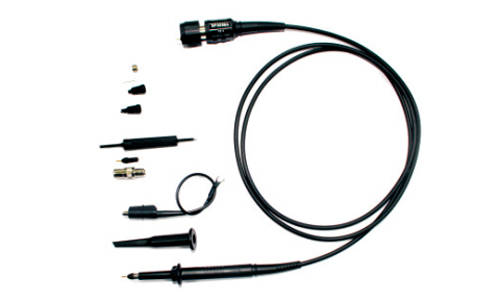
| Accessory kit | PAK2 — tips, ground leads and trim tool (€15) |
From the SIGLENT Probe Data Sheet. Errors and omissions excepted.
Other passive probes
Not sure this matches your oscilloscope?
Tell us the model and what you are measuring. Matching a probe to an instrument is usually a thirty-second answer — and buying more bandwidth than the scope can use is money wasted.