

Siglent SP2035A Auto-Sense 350 MHz Oscilloscope Probe

Siglent SP2035A 10X Auto-Sense attenuation,12 pf,10 Mohm,
350 MHz,CAT Ⅱ 300 Vrms,operating temperature -10 to 55 degrees
350 MHz passive probe, 10X auto-sense
The SP2035A is a fixed 10X passive probe reaching 350 MHz with 12 pF at the tip — noticeably less loading than the roughly 20 pF a switchable probe presents, which is exactly how it gets the extra bandwidth.
It carries an auto-sense ring, so a Siglent oscilloscope recognises the 10X attenuation and sets the channel scaling itself — one less thing to get wrong when the reading looks ten times off. On any other oscilloscope it behaves as a normal 10X probe. Compensation range is 9–25 pF.
Key specifications
- Bandwidth 350 MHz
- Fixed 10X attenuation
- 10 MΩ ±2% input impedance
- 12 pF input capacitance — lower loading than a switchable probe
- Auto-sense: Siglent scopes set the scaling automatically
- Compensation range 9–25 pF
- 300 V RMS CAT II
- 130 cm ±2 cm cable · 55 g
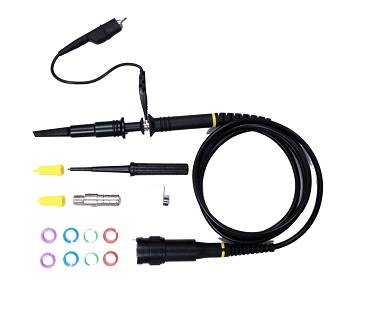
Application examples
Faster digital work
350 MHz and 12 pF handle edges that a 100 or 200 MHz switchable probe visibly rounds off.
Where mis-set attenuation has bitten you before
Auto-sense means the oscilloscope knows it is a 10X probe. Readings that are silently ten times wrong are one of the most common measurement mistakes there is.
Upgrading the probe rather than the oscilloscope
On a 200–350 MHz scope, a better probe often recovers more real bandwidth than the specification sheet suggests.
Specifications
| Attenuation rate | 10X (fixed) |
|---|---|
| Bandwidth | 350 MHz |
| Input impedance | 10 MΩ ±2% |
| Input capacitance | 12 pF |
| Compensation range | 9 pF – 25 pF |
| Input voltage | 300 V RMS CAT II |
| Attenuation sensing | Auto-sense ring — recognised by Siglent oscilloscopes |
| Operating temperature | −10 °C to +55 °C |
| Cable length | 130 cm ±2 cm |
| Weight | about 55 g |
From the SIGLENT Probe Data Sheet. Errors and omissions excepted.
Other passive probes
Not sure this matches your oscilloscope?
Tell us the model and what you are measuring. Matching a probe to an instrument is usually a thirty-second answer — and buying more bandwidth than the scope can use is money wasted.